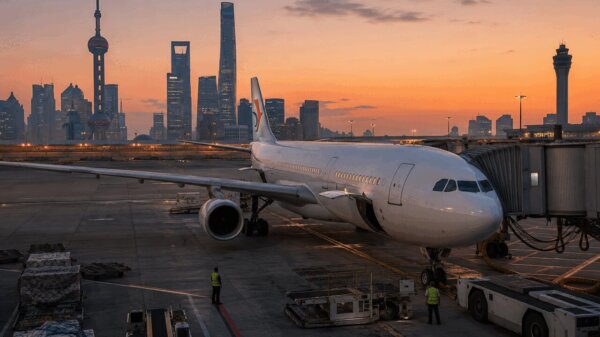
Singapore Airlines has decided that “good enough” internet is no longer good enough for a flagship carrier. On 4 May 2026, the airline said it will bring Starlink connectivity to its Airbus A350-900 long-haul fleet, A350-900 ULR aircraft, and A380s, with rollout starting in the first quarter of 2027 and running through the end of 2029. That matters because SIA is not just adding Wi-Fi; it is trying to lock in a premium advantage in the part of the market where passengers are most willing to pay attention.
What happened
Singapore Airlines already offers complimentary Wi-Fi more broadly than most major carriers, but this move is about quality, not just availability. The airline said Starlink will be introduced progressively across its long-haul and ultra-long-haul aircraft, giving customers faster and more seamless connectivity from take-off to landing.
The scale of the announcement matters. SIA is not testing one subfleet or reserving the upgrade for a handful of showcase planes. It is targeting the aircraft that define the airline’s long-range brand: the A350 long-haul variants and the A380.
The customer promise is also fairly clear. SIA says customers in all cabin classes on those aircraft will benefit from the better connection, while Suites, First Class, Business Class, PPS Club members, and KrisFlyer members in Premium Economy and Economy will continue to receive unlimited complimentary Wi-Fi on Starlink-enabled aircraft.
Why it matters
This is one of those product stories that looks cosmetic until you remember how people actually travel now. For long-haul business travelers, premium leisure passengers, and ultra-long-haul flyers in particular, connectivity is no longer a novelty. It has become part of the seat, part of the schedule, and part of the brand.
Singapore Airlines has long sold calm, polish, and reliability. Starlink lets it update that formula for a market that increasingly expects to stream, work, message, and upload in real time. In effect, SIA is trying to make the cabin feel less like a disconnected bubble and more like an extension of the passenger’s normal day.
There is also a competitive angle here. Airlines across Europe, the Gulf, and Asia are now racing to upgrade onboard connectivity, and the winners will be the ones that make the service feel invisible rather than intermittent. If SIA gets this right, it raises the bar not just for Southeast Asia, but for the global long-haul premium segment.
What travelers should watch
The first thing to watch is whether the rollout stays focused on the premium halo aircraft or expands further. If SIA proves that Starlink materially improves customer satisfaction, pressure will build to extend it to more of the fleet.
The second is how generous the airline remains with access. Free Wi-Fi is one thing; genuinely fast free Wi-Fi is another. If SIA manages to preserve both, this becomes a meaningful loyalty advantage for KrisFlyer and PPS Club members.
Third, there is the subtle but important ultra-long-haul angle. On flights that can stretch toward the limits of human patience, better connectivity can change how exhausting the trip feels. That is not a small detail when you are flying the kind of missions Singapore Airlines is famous for.
My take
This looks like a smart, brand-consistent move rather than a flashy one. Singapore Airlines is not trying to be noisy about technology for its own sake. It is using technology to reinforce an identity it already has: dependable, premium, and a little obsessive about the details that shape a journey.
The broader lesson is that airline product competition is shifting upward again. Seat design still matters. Lounges still matter. Loyalty still matters. But a bad internet experience now feels oddly anachronistic on a flagship long-haul flight. Singapore Airlines seems to understand that better than most.